Sermon: True Obedience – Galatians 3:10-29
I preached again!
Here is the video and PowerPoint for the Palm Sunday message at Paulden Christian Fellowship.
Archive for the ‘ Faith ’ Category
I preached again!
Here is the video and PowerPoint for the Palm Sunday message at Paulden Christian Fellowship.
If you confess with your mouth, “Jesus is Lord,” and believe in your heart that God raised him from the dead, you will be saved.
Romans 10:9, CSB
When we believe and confess the life, death, resurrection, and ascension of Christ, we are saved. We must believe in His divinity and humanity as well as His atoning sacrifice for our sins.
“Blessed is she who has believed that the Lord would fulfill what he has spoken to her!”
Luke 1:45, CSB
God told the prophets Jesus was coming, and He came. He said He is coming again. Let us join with Mary in believing the Word of the Lord that God is with us.
“The Lord is the one who will go before you. He will be with you; he will not leave you or abandon you. Do not be afraid or discouraged.”
Deuteronomy 31:8, CSB
A life of holiness relies on Christ in all things, realizing God is always with us and guiding our steps as we trust Him.
Now faith is the reality of what is hoped for, the proof of what is not seen.
Hebrews 11:1, CSB
God has come to us, and we do not believe blindly but because He has demonstrated His faithfulness and proved it all through the life, death, and resurrection of Jesus Christ.
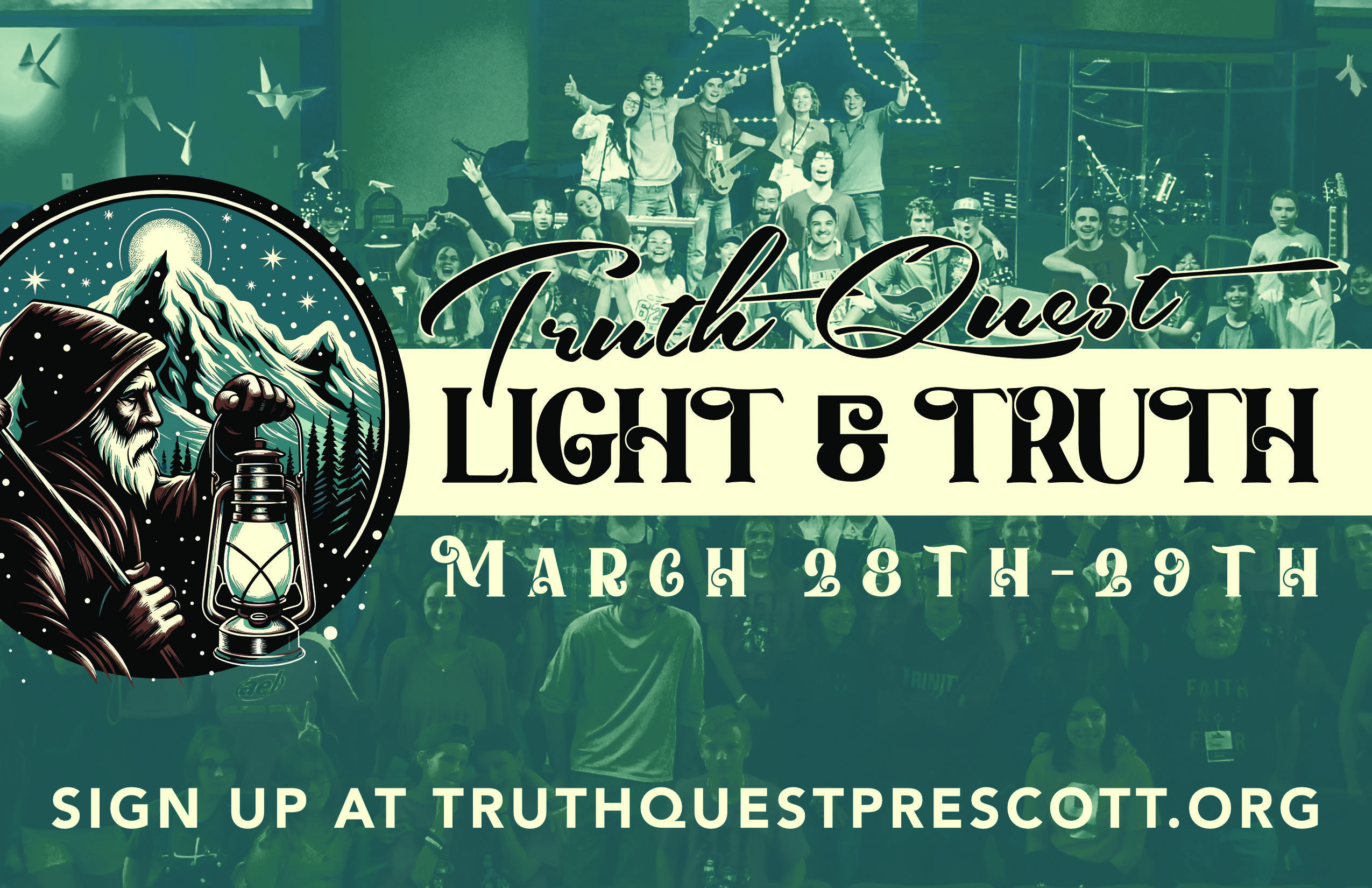
The annual Truth Quest Youth Apologetics Conference in Prescott, AZ, happened again! The theme this year was “Light & Truth”. It was Friday and Saturday, March 28-29, 2025, and I was blessed and able to change it up this year and give a presentation on Doubt & Deconstruction.
The extra blessing this time was my helpful panel for QnA discussion. Abi Marshall from Cornerstone Church and both Noah Ulrich and Freddy Garcia from Quad City Church filled out the panel.
Below are the video, my presentation, and the notes. (As usual, I mostly stuck to notes, but not completely.)
(Oh, and my hat states, “Be Nicene. It’s that simple.” with the chi rho symbol making the “p” in simple. It can be found at the More Than Cake store.)
(Recording from the event by the host: https://youtu.be/BnuptZ6b-IQ?si=wOammWbBKAZG4CED)
My presentation (slides): https://prezi.com/view/QVKTOsS1vJ48wTehlPbg/
Yet,
What about people who doubted in the Bible?
Many if not most who deconstruct their faith begin with doubts.
• Doubts that the Bible is reliable.
• Doubts that Jesus said/did the things in the Bible.
• Doubts about how Christians treat others.
Most of the prominent people who deconstructed said it was usually one of four things:
When it comes to defining deconstruction, Alisa Childers and Tim Barnett, in chapter 1 of their book The Deconstruction of Christianity, argue that there is not a clear definition, finding as many as eleven definitions in their research.
Deconstruction broadly can be understood as moving away from historical Christian teachings and often to de-converting, or it can be understood as the process of re-examining the beliefs you grew up with (p. 10).
We should be careful, though, as most who proclaim their deconstruction publicly have fallen away from the faith, but even Alisa Childers explained in her first two books (Another Gospel and Live Your Truth & Other Lies) that she went through a deconstruction due to her pastor (at the time) but came out stronger.
It helps to know that deconstruction has its roots in the teachings of French philosopher Jacques Derrida. He argued that words do not have inherent meanings, so everything should be questioned, especially in literature, philosophy, and political institutions. The only context of words is what we make of them.
This gets applied to religion when we begin to question the meanings of biblical texts and role of the Church. Most people have never heard of Derrida, but they apply his methods when they begin to have doubts about what is true (usually based on how they feel.)
Premise 1: Words do not have inherent meaning.
Premise 2: If no one agrees on the meaning, then I can decide what everything means.
Conclusion: I decide what is right and wrong based on my own definitions.
[Why argue there is no meaning to then apply some meaning?]
[If there is no inherent meaning, then nothing is true. Yet people get upset when we define things the way they don’t like.]
The biggest issue is that this thinking uses Christian definitions of right and wrong while claiming there is no absolute right and wrong. Then, it is argued that Christians are those who are wrong based on derived definitions (that may change at any moment), and the Christians should accept the changing definitions as true.
“Let everyone decide what is right for them, and if you don’t then you’re wrong!”
[Judges 21:25b]
If these are all true, then it can be argued that, if God exists, He also changes with society. Or God can be whatever we want Him to be.
If there is no absolute truth (a statement that refutes itself by having an absolute), then everyone can do what they want. But if there is absolute truth, then it must be discovered and applied.
If there is no absolute truth, how can anyone apply their truths to others? But if there is absolute truth, then it must be true for everyone.
Therefore, deconstruction is dangerous, because it removes meaning to be filled with whatever makes us feel better. We might use the ideas of some other people, but we don’t have to use the ideas of the original writers, including of the Bible.
“Who cares what the original intent was, this is how I see it.”
What keeps this logic from being turned around on the person deconstructing or transitioning or having some epiphany?
Deconstruction is dangerous because it makes personal circumstances and feelings general reality, feeding personal bias rather than seeking actual truth.
This then leads to falling into several logical fallacies:
Our response should always be the same:
No one can have 100% assurance of anything in this life (at least from a scientific point of view.)
It’s okay to say, “I don’t know” or “Let me look into that.”
Have mercy on those who doubt (Jude 1:22). Love others and listen to them (Lev. 19:18; Matt. 22:39; Mark 12:31; Luke 10:27; Romans 13:9; Galatians 5:14; James 1:19-20 & 2:8). Be honest (Luke 8:15). Seek truth (John 4:23) not “my truth” (Romans 2:8).
Give us today our daily bread.
Matthew 6:11, CSB
Life is hard. God is good. He provides all of our needs and cares for us, and He invites us to ask and trust Him.
God is in control.
He’s got this.
Regardless of who is in power.
Trust Him.
“The Lord is the one who will go before you. He will be with you; he will not leave you or abandon you. Do not be afraid or discouraged.”
Deuteronomy 31:8, CSB
He himself bore our sins in his body on the tree, that we might die to sin and live to righteousness. By his wounds you have been healed.
1 Peter 2:24, ESV
We are saved in Christ alone, as He took all of our sinfulness, hatred, fear, and hostility on the cross. We can know we are saved, finding healing through the restored relationship with God.
“For in it the righteousness of God is revealed from faith for faith, as it is written, “The righteous shall live by faith.”
Romans 1:17, ESV
We are saved in Christ alone, not by blind faith but by knowing He lived, died, and arose again, the Son of God made flesh.

 a simple man of God