Since October 2015 I have blogged responses to alleged Bible contradictions listed on the Skeptic Annotated Bible. I did not realized until making this post that this has been over ten years! Apparently this week I hit a milestone: I have refuted three hundred fifty alleged Bible Contradiction! Below is the listing of these […]
and every proud thing that is raised up against the knowledge of God, and we take every thought captive to obey Christ.
2 Corinthians 10:5, CSB
We watch our lives, knowing people will find any reason to reject the gospel, so we do not give them any valid argument but defend truth with biblical arguments. The Holy Spirit helps us in every moment.
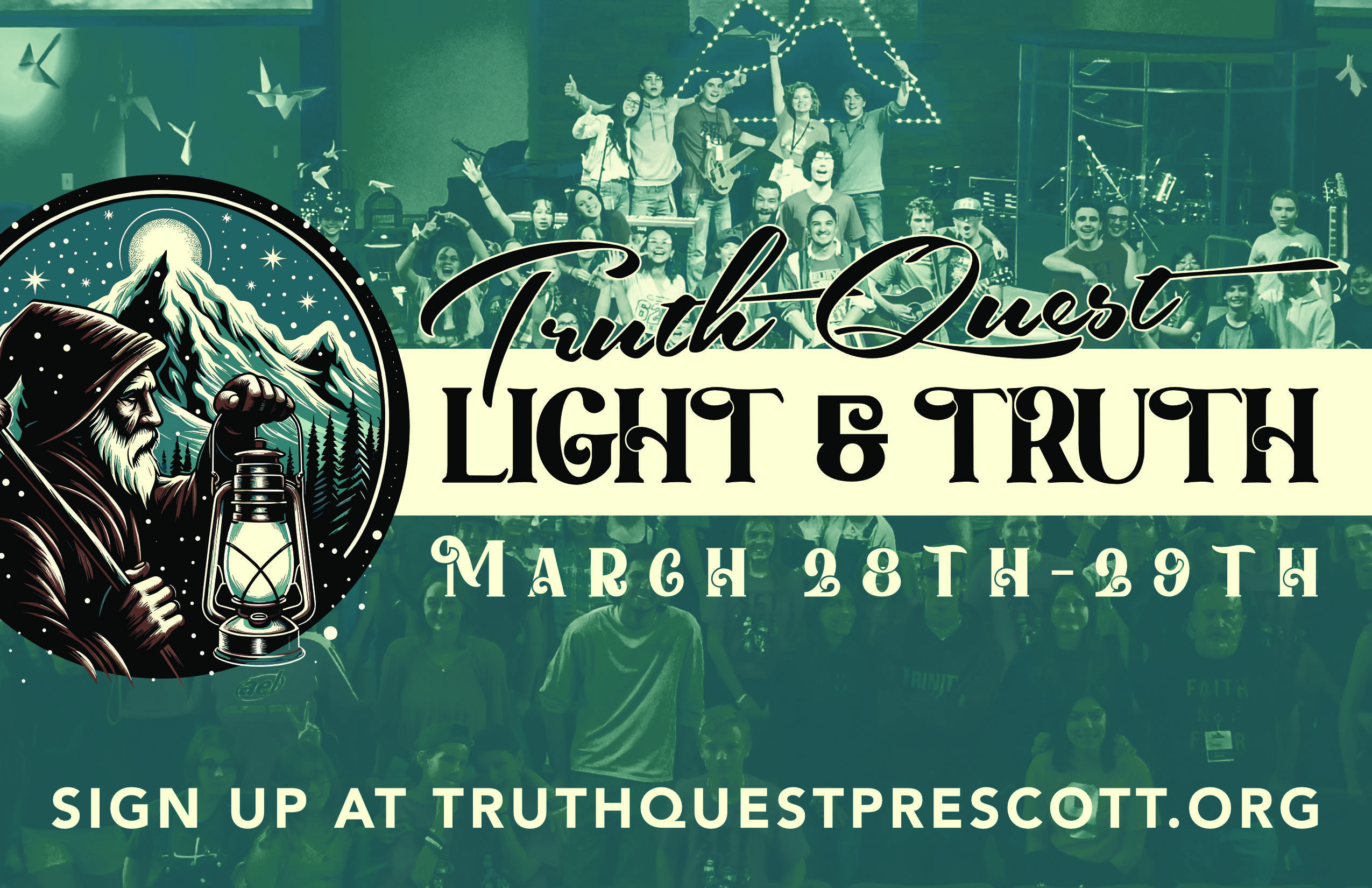
The annual Truth Quest Youth Apologetics Conference in Prescott, AZ, happened again! The theme this year was “Light & Truth”. It was Friday and Saturday, March 28-29, 2025, and I was blessed and able to change it up this year and give a presentation on Doubt & Deconstruction.
The extra blessing this time was my helpful panel for QnA discussion. Abi Marshall from Cornerstone Church and both Noah Ulrich and Freddy Garcia from Quad City Church filled out the panel.
Below are the video, my presentation, and the notes. (As usual, I mostly stuck to notes, but not completely.)
(Oh, and my hat states, “Be Nicene. It’s that simple.” with the chi rho symbol making the “p” in simple. It can be found at the More Than Cake store.)
TQ25 – Workshop: Doubt & Deconstruction: How can I keep my faith?
Jesus said that if we have faith and DO NOT DOUBT, we could command a mountain to be thrown into the sea (Matthew 21:21; Mark 11:23).
James said to ask for wisdom without doubting or be like one tossed on the sea, unstable in our thinking (1:5-8).
Many preachers and teachers have said to never ask questions, just have faith.
Doubt is often associated with fear, and John says there is no fear in love (1 John 4:18).
Yet,
Jude said to have mercy on those who doubt (1:22), and even some who followed Jesus after the resurrection had doubts (Matthew 28:17).
King David asked where God was (Psalm 22), or the other psalmists who wondered if God was truly helping (ex: Psalms 74, 77, 79, 88), yet they still reached out for God.
What about people who doubted in the Bible?
Abraham – Was not sure he could have children in his old age (even trying to make it happen.)
Moses – Doubted he could be used by God.
Elijah – Doubted he could be kept safe, even after defeating 450 priests of Baal miraculously.
Mary?
Was not sure how she could have a child without a husband. (Luke 1:34)
May have doubted Jesus’ sanity (Mark 3:21)
Mary Magdalene – Doubted Jesus’ resurrection
John the Baptist – Was imprisoned and had doubts that Jesus was the coming Promised One.
Thomas – Doubted Jesus was really resurrected.
John Mark – Doubted he could be useful or safe when sharing the gospel (and then wrote the Gospel of Mark).
What is “deconstruction”?
Many if not most who deconstruct their faith begin with doubts.
• Doubts that the Bible is reliable. • Doubts that Jesus said/did the things in the Bible. • Doubts about how Christians treat others.
Most of the prominent people who deconstructed said it was usually one of four things:
Christians avoiding talking about difficult things, including Bible passages and Christian history;
Christians being unscientific or anti-scientific;
Christians not loving neighbors through accepting LGBT, other faiths, or immigrants;
and pastors, teachers, and others abusing power, making “it all about them,” or spiritually abusing others.
When it comes to defining deconstruction, Alisa Childers and Tim Barnett, in chapter 1 of their book The Deconstruction of Christianity, argue that there is not a clear definition, finding as many as eleven definitions in their research.
Deconstruction broadly can be understood as moving away from historical Christian teachings and often to de-converting, or it can be understood as the process of re-examining the beliefs you grew up with (p. 10).
We should be careful, though, as most who proclaim their deconstruction publicly have fallen away from the faith, but even Alisa Childers explained in her first two books (Another Gospel and Live Your Truth & Other Lies) that she went through a deconstruction due to her pastor (at the time) but came out stronger.
It helps to know that deconstruction has its roots in the teachings of French philosopher Jacques Derrida. He argued that words do not have inherent meanings, so everything should be questioned, especially in literature, philosophy, and political institutions. The only context of words is what we make of them.
This gets applied to religion when we begin to question the meanings of biblical texts and role of the Church. Most people have never heard of Derrida, but they apply his methods when they begin to have doubts about what is true (usually based on how they feel.)
Let’s start with a simple syllogism:
Premise 1: Words do not have inherent meaning. Premise 2: If no one agrees on the meaning, then I can decide what everything means. Conclusion: I decide what is right and wrong based on my own definitions.
What is wrong with this argument?
[Why argue there is no meaning to then apply some meaning?] [If there is no inherent meaning, then nothing is true. Yet people get upset when we define things the way they don’t like.]
The biggest issue is that this thinking uses Christian definitions of right and wrong while claiming there is no absolute right and wrong. Then, it is argued that Christians are those who are wrong based on derived definitions (that may change at any moment), and the Christians should accept the changing definitions as true.
“Let everyone decide what is right for them, and if you don’t then you’re wrong!”
[Judges 21:25b]
If these are all true, then it can be argued that, if God exists, He also changes with society. Or God can be whatever we want Him to be.
This is already seen in our culture.
If there is no absolute truth (a statement that refutes itself by having an absolute), then everyone can do what they want. But if there is absolute truth, then it must be discovered and applied. If there is no absolute truth, how can anyone apply their truths to others? But if there is absolute truth, then it must be true for everyone.
Therefore, deconstruction is dangerous, because it removes meaning to be filled with whatever makes us feel better. We might use the ideas of some other people, but we don’t have to use the ideas of the original writers, including of the Bible.
“Who cares what the original intent was, this is how I see it.”
What keeps this logic from being turned around on the person deconstructing or transitioning or having some epiphany? Deconstruction is dangerous because it makes personal circumstances and feelings general reality, feeding personal bias rather than seeking actual truth.
This then leads to falling into several logical fallacies:
Hasty generalization: applying to the whole from a small sample.
Strawman: claiming Christians believe certain things based on new definitions than the actual definitions historically used.
Ad hominem: attacking Christians for being horrible because of how others have acted.
Appeal to Authority: claiming authority that is not necessarily recognized, in this case personal experience as a greater authority than thousands of years of teachings and understandings.
And many more.
And to be fair, it is easy to fall into many fallacies when refuting those who fall away from Christianity.
For example, when it is claimed that all who deconstruct fall away (hasty generalization), that those who deconstruct just want to enjoy their sin and cause harm to others (potentially strawman and/or ad hominem), or that we have to believe because the Church has taught this for 2000 years (potentially appeal to authority.)
Because of these issues and problems, Childers and Barnett argue for saving deconstruction for those who fall away from the Christian faith.
What should I do?
Their suggestion is to say Christians go through “Reformation” rather than deconstruction.
Doubt is like pain. It is a warning of danger: Watch out for lies!
Don’t Lie or Avoid!
There is value in Derrida’s and the deconstructed people’s view of examining beliefs and definitions. Words do have meaning, but meanings can and do change. (Consider the word “gay” changing.)
Church hurt is real. It should be dealt with.
Abuses are real. People in power should be disciplined or removed for abusing power. Those who spiritually, emotionally, or physically abuse others should be removed from power, possibly even sent to prison.
Doubts are real. Sometimes from ignorance and sometimes from zeal for God, people avoid discussing certain topics.
We must be willing to tackle the hard problems with charity, love, and compassion in a reasonable manner.
There are passages that seem problematic, possibly contradicting or inconsistent.
To claim they have never been talked about or addressed is either a lie or a sign of laziness in research. The Bible has been attacked for 2000 years, yet it continually withstands the attacks, either because they were weak attacks or refuted.
No, the Bible does not support polygamy when it discusses all the men who married multiple women. It does not support chattel slavery (like seen in the colonies and nation of America in the 1600-1800s), as stealing people and treating them like animals or worse is specifically condemned.
There are words that change meanings, but intent in meaning matters.
It’s true that the word “homosexuality” was invented in Germany in the 1860s and not put into an English translation of the Bible until the Revised Standard Version of 1946 used it in 1 Corinthians 6:9. Yet, the original meaning of both “homosexual” and “arsenokoitai” (the Greek term Paul wrote) is the same.
It’s true that the King James Bible and others mention unicorns and dragons, words that mean “animals with one horn” and “scaly lizards” in a general sense. (The original 1828 Webster’s Dictionary even saying “unicorn” often refers to a rhinoceros, and consider the Komodo dragon also known as the monitor lizard.)
The Bible was not compiled at Nicaea and then translated and retranslated over and over throughout the centuries.
The Council of Nicaea primarily was to resolve the Arianism debate and set a standard date for Easter (not a pagan holiday) amongst some other items. We have manuscripts going back to the 2nd Century for the New Testament (possibly the 1st Century, but either way within 100 years of the writers) and before the time of Christ for the Old Testament (showing they were written before His life on Earth) that show the same texts as manuscript copies from the past 1000 years. Nearly all the changes are minor spelling differences or word order, nothing affecting doctrine. Modern translations look at all available manuscripts (families) to be as close to the original as possible. Translations also deal with language drift and changes. (“Nice” originally meant something quite opposite to today.)
People have done horrible things in the name of God and the Church.
This can be a reason for doubts, but if it is the only reason that is foolish. People have done horrible things for all sorts of reasons. We don’t avoid all restaurants for some bad service at one restaurant. We don’t avoid YouTube or TikTok because of some bad videos people made. Remember, atheists have done horrible things, people in other religions have done horrible things. We should focus on what the founder of Christianity called for (no, it was not Paul). If we can love the teachings but not the followers, then actually look at the teachings.
Our response should always be the same: No one can have 100% assurance of anything in this life (at least from a scientific point of view.) It’s okay to say, “I don’t know” or “Let me look into that.” Have mercy on those who doubt (Jude 1:22). Love others and listen to them (Lev. 19:18; Matt. 22:39; Mark 12:31; Luke 10:27; Romans 13:9; Galatians 5:14; James 1:19-20 & 2:8). Be honest (Luke 8:15). Seek truth (John 4:23) not “my truth” (Romans 2:8).
Bibliography:
Childers, Alisa and Tim Barnett. The Deconstruction of Christianity: What it is, why it’s destructive, and how to respond. Carol Stream: Tyndale House, 2023.
Lawlor, Leonard, “Jacques Derrida”, The Stanford Encyclopedia of Philosophy (Summer 2023 Edition), Edward N. Zalta & Uri Nodelman (eds.), accessed March 7, 2025, https://plato.stanford.edu/entries/derrida/
There was an online discussion about Christianity that have gone viral. This is between Christian historian and apologist Wes Huff and Billy Carson an Internet personality of sorts. Here’s the video:
I might do my own response(s) to these someday, but these are some good thoughts.
Daniel
Pictured is the “The Ten Non-Commandments.” It’s originally from a page on Facebook called Unite Women. My response led to a four part series. Here is the table of contents:
Over the years we see the increase hostility of the secular leftists against Christianity. I remember sometime ago I wrote “Anti-Christian latest intolerance: Swiss Christian Chocolate Company.” I thought I share some thoughts related to this from an apologetics dimension with how this version of tolerance pushed by the elites today is intellectually bullet ridden.
If you been a Christian for any time you would have heard of 2 Timothy 4:2: preach the word; be ready in season and out of season; correct, rebuke, and exhort, with great patience and instruction.
Jimmy’s thoughts are timely, as our congregation is going through Proverbs on Sunday mornings. It’s also a good reminder in an election year in the good ol’ US of A, especially.
May we learn how to pick our battles and answer wisely.
Daniel
I have been thinking about the topic of not answering a fool.
The annual Truth Quest Youth Apologetics Conference in Prescott, AZ, happened again! The theme this year was “Truth & Freedom”. It was Friday and Saturday, April 12-13, 2024, and I was blessed and able to once again give the presentation “Does God Exist?”
I came in exhausted, so if I stumble through some parts, know that. The extra blessing this time was the addition of a panel for QnA discussion. Pastor Matt Kottman of our hosting church, Solid Rock Christian Fellowship, was our panel host. NextGen Pastor Titus Vester of Willow Hills Baptist was our fellow panelist.
Below are the video, my presentation, and the notes. (As usual, I mostly stuck to notes, but not completely.)
(Oh, and my shirt states, “If at first you don’t succeed, try doing what your math teacher taught you the first time.”)
“God does not exist.” • From etymology.com: from Latin – existere/exsistere = “to step out, stand forth, emerge appear” o Therefore, God does not exist • Just Kidding! It also means “to be”, and as we know God simply is. o Exodus 3:14: “I AM WHO I AM” or simply “I Am” Not “I was” or “I will be” or “I can be” – God eternally is. Can we know anything? Do we fall into the fallacies of infinite regress, that “there are turtles all the way down?” Perhaps we fall into circular reasoning. “We know this because of that, and that’s true because of this.” Infinite regress looks like asking, “If God created everything, then who created God?” Or “everything came from something before it.” Evolutionary theorists do these often, such as saying we know the age of rock layers because of the fossils we find, and we know the age of the fossils because of the rock layers they’re in. Ultimately, all arguments resort to circular reasoning, meaning it’s not necessarily a fallacy. However, with God the argument is that He is the uncaused first cause. But can we believe in God? What is faith? Blind faith – believing without evidence. True faith – belief in action based on evidence.
What is evidence?
Merriam-Webster: (all text original) “1a: an outward sign : INDICATION; b: something that furnishes proof : TESTIMONY; specifically : something legally submitted to a tribunal to ascertain the truth of a matter 2: one who bears witness; especially : one who voluntarily confesses a crime and testifies for the prosecution against one’s accomplices” Should be: Testable, Observable, and/or Confirmable o What is Gravity? How does it work? [Play video] , but it is a Law of Nature “However, if we are to be honest, we do not know what gravity “is” in any fundamental way – we only know how it behaves. Gravity is a force of attraction that exists between any two masses, any two bodies, any two particles. Gravity is not just the attraction between objects and the Earth” (NASA.gov – Retrieved February 28, 2023 from https://starchild.gsfc.nasa.gov/docs/StarChild/questions/question30.html#:~:text=However%2C%20if%20we%20are%20to,only%20know%20how%20it%20behaves.&text=Gravity%20is%20a%20force%20of,between%20objects%20and%20the%20Earth.) No one really understands how a bicycle stays upright even without a rider [minutephysics video – https://www.youtube.com/watch?v=oZAc5t2lkvo%5D
NASA helps us see that no one really understands gravity. Evidence of this is that no one really understands why the physics work that makes a bicycle stay upright, even without a rider. Can we scientifically measure … science? Science comes from the Latin for knowledge, and it is a PROCESS for evaluating evidence. “Christianity does not profess to convince the perverse and headstrong, to bring irresistible evidence to the daring and profane, to vanquish the proud scorner, and afford evidences from which the careless and perverse cannot possibly escape. This might go to destroy man’s responsibility. All that Christianity professes, is to propose such evidences as may satisfy the meek, the tractable, the candid, the serious inquirer.” Bishop Wilson, Evidences of Christianity, 1.38. “Christians do not claim that their faith gives them omniscience or absolute knowledge of reality. Only God has that. But they believe that the Christian account of things – creation, fall, redemption, and restoration – makes the most sense in the world.” Timothy Keller, The Reason for God, p. 127
Evidence
Naturalism vs. Theism • Naturalism believes that nature is the only thing that has creative properties so they reject any creative force outside the box (the universe). • “That is, science is assumed to be, not only rational and causal and unified, but also naturalistic, banning by definition even the possibility of a supernatural First Cause of the rationality, causality, and unity of the universe with which science deals. But such an assumption is purely arbitrary (even emotional, as Isaac Asimov had admitted) and was certainly not held by the great scientists of the past, nor is it indicated by any actual scientific data.” (Dr. Henry M. Morris, The Biblical Basis for Modern Science, p.23) BIAS Let’s remember that we all have the same evidences, but we bring our own biases. It is closed minded and unscientific to only believe in the material. We all have bias in our approach of discovery but which is the greater bias, naturalism or theism? “The current bias of science arbitrarily eliminates certain answers before the game gets started. Many scientists and historians must come up with conclusions that leave the supernatural out of the picture because their philosophy demands it. A theist is not so encumbered. She believes in the laws of nature, but is also open to the possibility of supernatural intervention. Both are consistent with her worldview. She can judge the evidence on its own merits, unhindered by a philosophy that automatically eliminates supernatural options before the evidence receives a hearing. Ironically, Christians bias broadens her categories making her more open-minded, not less. She has a greater chance of discovering truth because she can follow the evidence wherever it leads.” -Greg Koukl, Tactics, p.174-175 “For me it is more reasonable to believe, based on the laws of logic as well as the observable scientific evidence that God exists, rather than to believe what the atheist believes that nothing, times nobody, equals everything we see in the universe.” -Charlie Campbell, http://www.alwaysbeready.com/component/content/article?id=137 Isn’t it interesting that the first “scientists” were all theologians or Christians in their respective disciplines? Why? Romans 1:20 … This is called “General Revelation.”
The Cosmos
“Cosmogony is the study of ideas about the origin of the cosmos. The term is closely related to cosmology, which is the study of the cosmos in all its aspects.” -Dr. Henry M. Morris, The Biblical Basis for Modern Science, p.119 What is the cosmos? “The cosmos, in simplest terms, is the space-mass-time universe and all its arrays of complex systems…God created the heavens (i.e., ‘space’) and the earth (i.e., ‘matter’) in the beginning (i.e., ‘time’).” -Dr. Henry M. Morris, The Biblical Basis for Modern Science, p 119
Kalam Cosmological In 1979, Christian philosopher William Lane Craig published his research on the Kalam Cosmological Argument, reduced to a simple syllogism (“1. This is a truth, 2. This is a fact about something, therefore 3. This fact is true.): 1. Everything that begins to exist has a cause. 2. The universe began to exist. 3. Therefore, the universe has a cause. Taken a few steps further, here are other arguments he has posited: 1. Something exists. 2. Nothing does not produce something. 3. Something must have always existed, leaving two options: either the universe or something outside of the universe. 4. If the universe were infinite, we could never arrive at “Today” because time would never truly advance. Math would fail. For time to work, a beginning is necessary. Entropy helps prove this, as all things break down over time. (Time is not an illusion, it is merely affected by other things, such as speed and energy … and gravity.) Thus, the universe must have had a beginning with a cause. 5. If the universe has a cause, then an uncaused, personal Creator of the universe exists who sans (without) the universe is beginningless, changeless, immaterial, timeless, spaceless, and enormously powerful, because an effect cannot be greater than its cause. 6. Therefore, an uncaused, personal Creator of the universe exists, who sans the universe is beginningless, changeless, immaterial, timeless, spaceless, and enormously powerful. “The most basic scientific principle, and the criterion that governs all human experience, is the law of causality. This law states that although one cause can have many effects, no effect can be either quantitatively greater than or qualitatively superior to it’s cause. An effect can never be greater and, in fact, will always be less-than it’s cause. Thus a chain of effects and their cause must eventually trace to an essentially infinite first cause.” -Henry Morris, The Biblical Basis for Modern Science We all know that nothing happens in isolation. When we try to trace an event to it’s cause, or causes, we find that we never seem to reach a stopping point. The cause of an event itself caused by a prior cause, and so on back. Eventually we must face the question of a possible uncaused First Cause. The universe itself is evidence. Why?
Fine-Tuned Universe • Fine-Tuning of the Universe o [Fine-Tuning of the Universe video by Reasonable Faith] Some even suggest we may live in a simulation … which means … created … So, we have a universe that has a definitive beginning. (Even if arguments are being made saying otherwise.) It is so finely tuned that a severely minor change would mean at best no life and at worst no universe. And Christians get made fun of for discussing “elephants all the way down” (which is what a multiverse is) or something outside of the physical universe (showing they have faith in Science and human potential.)
DNA
There is so much complexity and fine-tuning in a universe with a beginning, and it includes biology. We could discuss all of the amazingly complex parts of biology that seem to be irreducibly complex, including the eye, of which Darwin himself was terrified to consider the complexity. “Biology is the study of complicated things that give the appearance of having been designed for a purpose.” -Richard Dawkins, The Blind Watchmaker “Biologists must constantly keep in mind that what they see was not designed, but rather evolved.” -Francis Crick, cited in William Dembski, Science and Design However, today we will focus on one element of biology in particular that ties to the very evidence scientists search for when they search for life in the universe: information … • Biology is an expression of information, i.e. DNA, and information only comes from a mind. • DNA – The code of life – Is it all a happy accident? o Francis Crick, one of the two scientists who discovered DNA, having observed the complexity of DNA, estimated that the odds that intelligent life exists on the Earth as the result of non-directed processes to be around … 1:102,000,000,000 (That’s one with ten to the two billionth power.) – [Cited in Gary Habermas and Mike Licona, The Case for the Resurrection, 2004, p. 179] o 01000111 01001111 01000100 00100000 01100101 01111000 01101001 01110011 01110100 01110011 This is binary, a code of just 2 characters, but DNA is made up of 4 characters that tell every living cell how to build itself, grow, and reproduce. This binary “GOD exists” The universe and life itself proclaims a Creator exists.
Jesus!
The ultimate proof of God is the death and resurrection of Jesus: He presented His physical body to His disciples. • Naturalism or Intelligent Design: both require faith because both cannot observe the past, but what is more probable? What is the most likely, reasonable reality? • Think 4th Dimensionally: o Hearing from an atheist … What is the supernatural? • “But we need more than naturalistic sciences. We cannot derive meaning, human value, and equality from a laboratory.” -Abdu Murray, Saving Truth, p. 173D Is there something outside of space and time? • The more we understand the cosmos the bigger and the more intricate the design is observed. We have to conclude that there is a God that is incredibly detailed, unfathomably large, and surpassing beautiful. What would a higher being be like? • [Flatlanders video by Carl Sagan from Cosmos] • It is perfectly reasonable to believe in a more than probable God who exists outside of space-time. • “For me it is more reasonable to believe, based on the laws of logic as well as the observable scientific evidence that God exists, rather than to believe what the atheist believes that nothing, times nobody, equals everything we see in the universe.” -Charlie Campbell, http://www.alwaysbeready.com/component/content/article?id=137 • The Ultimate Proof: Jesus presented Himself as God and proved it! o The Hebrew Bible (what we call the Old Testament) made over 100 distinct prophecies about One who would come to save all people from sin. o Jesus of Nazareth was born the way prophesied, lived a life performing miracles and pointing people to God, and then He said He would be killed and raised to life again. o And Jesus did that. Evidence? John 20:19-20, 24-29 o 1 Corinthians 15:17-24 Why? Did God need to create anything, especially us? No. Acts 17:24-25 – God is a free Being who has no need for anything. Did He have to save us? Did He have to become a human and die? No. He could have just destroyed us in our sin, but He was free to choose to save us out of His love for us. (Consider Genesis 6:5-7 [destroying the world by flood]; Exodus 32:9-10 and Deuteronomy 9:13-14 [wanting to destroy Israel for the golden calf]) Because of His freedom to choose us, if we choose to follow God, we become free from sin and shame, and one day all of creation will be free from corruption. Romans 8; 2 Corinthians 3:17; Galatians 5:1,13
Do we truly love the Lord our God with all our hearts, souls, minds, and strengths? Maybe I can help with the mind part, at least! This is Daniel M. Klem, apparent poet, reluctant yet passionate Disciple (Peter?), and foolish man attempting to understand theology!




 a simple man of God