One of the funniest moments of the 2003 film “Elf” was Buddy the Elf seeing a feral raccoon, spreading out his arms, and asking, “Does someone need a hug?” (It did not go well.)
Something I like to tell people is that on January 9, 2000, Jesus hugged me in welcome to His Family. On July 26, 2000, I finally returned the hug.
It is nice to think about receiving a comforting hug when life feels overwhelming, things are generally crazy, or having just gone through a horrible situation.
It is also nice to look back through the Bible and see how God has been there for His people:
In the Exodus, God said He rescued Israel with a mighty hand and outstretched arm (Exodus 6:6; Deuteronomy 4:34, 5:15, 7:19; Psalm 136:12).
Within Israel and their Exile, God welcomes those who come to Him humbly and for His glory (1 Kings 8:41-43; 2 Chronicles 6:32-33; Ezekiel 20:34).
We can see how God has been taking care of His people, yes even under judgment at times.
What is the most comforting is that God came to us to take the punishment we deserve for disobedience. He promised to do this when He spoke with Abraham 4,000 years ago (Genesis 15), and there are so many places that it is laid out in the Hebrew Scriptures (such as Genesis 22, Psalm 22, and Daniel 9:26).
Good Friday is good, because we see the Creator, the God of Abraham, Isaac, and Jacob, who saw all the sinfulness of this world, come to us in the midst of our fear, pain, and anxiety. The one who stretched out His arm with His might hands came to comfort us with those strong arms and hands.
So, on that terrible Friday 2,000 years ago, Jesus opened His arms for us. We are the feral raccoons, rooting around in garbage and attacking the God who loves us. He took the punishment we deserved, holding back God’s wrath for those of us who will believe.
Yet this same God who took on His own wrath, with those same strong, mighty, scarred arms, reaches out to us to hold us and comfort us.
When we look at the cross, we see God opening His arms to us.
Jesus on the cross took our pain, but it is God saying, “Who needs a hug? Because I am here.”
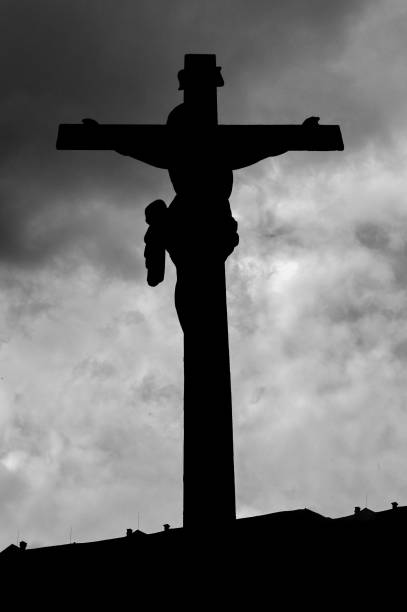
Statue of the Cross of Christ in Prague (Czech Republic )
He himself bore our sins in his body on the tree, that we might die to sin and live to righteousness. By his wounds you have been healed.
1 Peter 2:24, ESV
We are saved in Christ alone, as He took all of our sinfulness, hatred, fear, and hostility on the cross. We can know we are saved, finding healing through the restored relationship with God.
Jesus said to her, “Woman, why are you weeping? Whom are you seeking?” Supposing him to be the gardener, she said to him, “Sir, if you have carried him away, tell me where you have laid him, and I will take him away.” Jesus said to her, “Mary.” She turned and said to him in Aramaic, “Rabboni!” (which means Teacher).
John 20:15-16, ESV
Circumstances in life can make us miss the truth right in front of our own faces.
Don’t let grief, self-righteousness, pain, or good things blind you to the crucified and risen Christ who calls us by name.
But he was pierced for our transgressions; he was crushed for our iniquities; upon him was the chastisement that brought us peace, and with his wounds we are healed.
Isaiah 53:5, ESV
We deserved punishment and death for our rebellion against God, but Jesus took our penalty, as prophesied 700 years earlier.
I did NOT preach again, but my friend and fellow elder Bill did preach.
It was pretty cool.
You should be able to watch below.
Mark 15:16-32, ESV
And the soldiers led him away inside the palace (that is, the governor’s headquarters), and they called together the whole battalion. And they clothed him in a purple cloak, and twisting together a crown of thorns, they put it on him. And they began to salute him, “Hail, King of the Jews!” And they were striking his head with a reed and spitting on him and kneeling down in homage to him. And when they had mocked him, they stripped him of the purple cloak and put his own clothes on him. And they led him out to crucify him.
And they compelled a passerby, Simon of Cyrene, who was coming in from the country, the father of Alexander and Rufus, to carry his cross. And they brought him to the place called Golgotha (which means Place of a Skull). And they offered him wine mixed with myrrh, but he did not take it. And they crucified him and divided his garments among them, casting lots for them, to decide what each should take. And it was the third hour when they crucified him. And the inscription of the charge against him read, “The King of the Jews.” And with him they crucified two robbers, one on his right and one on his left. And those who passed by derided him, wagging their heads and saying, “Aha! You who would destroy the temple and rebuild it in three days, save yourself, and come down from the cross!” So also the chief priests with the scribes mocked him to one another, saying, “He saved others; he cannot save himself. Let the Christ, the King of Israel, come down now from the cross that we may see and believe.” Those who were crucified with him also reviled him.
I might need a new computer, because it, again, took a few days (better than last time, though!) to get this uploaded due to some technical issues.
As usual, my rough notes are below, just remember that they are rough notes and not necessarily everything I said.
Mark 10:32-52
MESSAGE:
vv. 32: Why were people amazed and afraid?
Possibly thinking about Jesus having just discussed how impossible it is to be saved unless God does it. (vv. 23-31)
Possibly seeing how resolutely Jesus is heading toward Jerusalem (Luke 9:51[-62?]).
Possibly because of what He said next:
vv. 33-34: Jesus explains His arrest, beating, and death, as well as His resurrection. Is it possible the disciples were amazed at the news, while others merely heard that He would die?
No one knows for sure. We see there are two groups: The 12 and others “who followed”.
Probably a combination of all of this: it is difficult (yet oh-so-easy) to be saved, Jesus looks determined to get to Jerusalem, and Jesus just predicted problems in Jerusalem. “Is the Messiah about to start the war that drives out the pagans and restores true worship?”
Honestly, none of them could see what was coming, even with Jesus explaining it in such detail. We know for two reasons: two Apostles making their request and the immediate healing of a man.
First, how the Apostles did not see clearly:
vv. 35-45: James and John (and their mom, as seen in Matthew 20) are clearly expecting Jesus to triumph and reign in Jerusalem, so they ask to sit at His right and left hand. They expect a quick and decisive victory. (Which definitely happened at the cross, but they can’t see that yet.)
The other Ten became “indignant” at their audacity. But at least they were looking towards Jesus’ ultimate glory. They knew and expected Jesus to be in glory, and they wanted to be with Jesus in glory! Shouldn’t we?!
We can see they are not seeing the whole picture, though. They each know they can “drink from the same cup” as Jesus, but, as usual, Jesus takes it deeper: “Indeed, you will,” but it is not as rulers as the world understands ruling. “For the Son of Man came not to be served but to serve”. So, too, we as Christ followers are to serve each other.
How?
“For even the Son of Man came not to be served but to serve, and to offer His life as a ransom for many.”
We must [READ Philippians 2:3-5] “Do nothing from selfish ambition or conceit, but in humility count others more significant than yourselves. Let each of you look not only to his own interests, but also to the interests of others. Have this mind among yourselves, which is yours in Christ Jesus”. How do we know the Apostles were not seeing things this way? (At least not yet?)
vv. 46-52: Here is a blind man, crying out for the promised Messiah, “Jesus, Son of David, have mercy on me!” A crowd – including the Apostles – are trying to quiet Him down and shoo him away. “The Teacher has no time for someone like you. Quiet!”
But this man can see who is nearby. This BLIND MAN can clearly see the Son of God is walking by. He cries out louder, more urgently, knowing this is his only chance to be healed. They are still getting indignant at the audacity of others wanting to be near Christ.
And notice the change in everyone when Jesus finally speaks “Call him”: “Oh, hey, friend, come see Jesus,” they sweetly say to this poor helpless man. We see that the APOSTLES OF JESUS are still missing the point that “the Son of man came not be served but to serve”.
And notice how Jesus heals.
Remember a couple chapters ago when Jesus healed a blind man in Bethsaida? He spits in the man’s eyes and covers them with his hands. This time, He merely speaks, “your faith has made you well.” (Reminds me of Moses and water from the rocks: First he tapped a rock with his staff, the second time he was supposed to only speak to it. A reminder that a greater Prophet than Moses has finally come.)
Quick Mini-Lesson:
Quick lesson on literary/biblical terms: One of Caitlin’s favorites: Pericope – an excerpt from a text that forms a complete thought. We had three pericopes today: Jesus predicting His crucifixion, James and John requesting a place of honor, and the healing of Bartimaeus.
Chiastic structure – a poetic writing style that flows (often in a circular way or in an arc) so that themes are repeated in reverse order. As an example (from Genesis 9:6):
A – Whoever sheds B – the blood C – of man, C’ – by man B’ – shall his blood A’ – be shed
Sometimes, there is a hinge that it all swings around. For example, Proverbs 31:10-31 extols the virtues of a godly woman, following a long chiastic structure, with a “hinge” in verse 23 about her husband: “Her husband is known in the gates when he sits among the elders of the land.”
The greatest chiasmus is the entire Bible:
A – Creation of Paradise B – The Fall into sin C – The spread of sin D – Christ’s Life, Death, and Resurrection C’ – The spread of the Gospel B’ – Christ’s return and final redemption from sin A’ – Restored Paradise
Our big chiasmus from Mark:
A – 8:22-26 – Blind man healed B – 8:27-30 – Peter’s Confession of Christ C – 8:31-9:1 – Christ’s 1st Foretelling and Peter’s “tempting” Jesus with rebuke D – 9:2-13 – Christ’s Transfiguration into glory as God’s true Son E – 9:14-30 – Christ is greater than spirits by healing a child F – 9:30-32 – Christ’s 2nd Foretelling of His Crucifixion & Resurrection E’ – 9:33-37 – Disciples argue who is greater, Christ’s call to childlikeness D’ – 9:38-10:31 – Those who tempt others to sin and turn from God’s truth, instead accepting His glory C’ – 10:32-34 – Christ’s 3rd Foretelling B’ – 10:35-45 – Apostles acknowledge Christ and His glory A’ – 10:46-52 – Blind Bartimaeus healed
So what?
Mark is pointing out to us how blind we are to God’s truth. We need God to reveal Himself to us, because we tend to think we know better … or that truth can’t be known or is relative or up to each person.
No, Mark is showing us through these pericopes that Jesus came to work, to serve other people. We start with the Son of God showing us He is our Creator and Healer by healing a blind man. We can easily confess Christ as the Son of God while still not seeing Who He really is. And then Jesus predicts His death and resurrection.
Then after the failure of the Apostles to catch on, He predicts it again, that hinge of these stories, reminding us to innocently believe in Him and not distract others.
He predicts it again and drives the point home how blind we are to truth by healing another blind man WITH ONLY HIS WORDS.
Blindness. Revelation. We mess up. Revelation. We mess up. Revelation. Blindness.
We foresee Christ’s passion in the midst of our pride and persistence to think we have it figured out. Fortunately, He is more persistent than we are, and motivates us to be more persistent.
It can be awesome and intimidating to think about the Creator and Sustainer of the Universe coming after us, but it is all because of His love for us and for the Father’s glory.
RESPONSE:
We cannot begin to understand God and His ways (Isaiah 55:8), but we can let Him open our eyes to what He is doing.
We can look to our Savior and see that our Maker and Savior came to us to set the example of how to serve others with sacrificial love and compassion.
For all people.
We can see that He is the God who heals. He may not physically heal us in this life, but by His resurrection we have the hope of eternity free from pain, suffering, and fear.
We should be zealous for a God who saw us in our pride and misunderstandings yet loved us enough to come die for us, to open our eyes to truth and forgive us.
APPLICATION:
How then should we live?
How do we treat people? How do we treat God?!
It can be so easy to get upset with others when we think they are wrong. We can get indignant with their seemingly overblown sense of passion for something, or that they are interfering with important matters.
Do we remember that sometimes (many times?) we each can be the seemingly overblown, interfering person?
We need to remind ourselves that we don’t know everything. But we know the One who does and sees each person, their circumstances, and their lives.
We need to ask Him to open our eyes to what He is doing in their lives … and our own.
We need to ask Him to reveal our own blindness toward others, ourselves, and His glory.
We need to be passionate about the things of God, to want to do the Father’s work in the name of Jesus by the power of the Holy Spirit.
And how?
We read His Word. We get into the Bible: individually, with others, and when we meet as the Church. We must be learning what He has revealed through Scripture and listening to those who have put in the time and training to be teachers and pastors, but always comparing what they say (and write) with the Bible. (Like the Bereans in Acts 17) And we need to be telling others the truth of Christ. It shows we truly believe He is the promised Messiah, the Son of David, the Son of God who takes away the sin world. This is how we acknowledge His glory. We should be passionate about sharing Christ with others, unable and unwilling to be told to be quiet about our Great Healer God.!
There are a few items that prove the historicity and reliability of the Bible.
To begin with, in the last 20 years alone, several archaeological discoveries have been made confirming the existence of Kings David and Solomon, as well as much of ancient Israel from Biblical times, including NT times.
One of the greatest discoveries was the Dead Sea Scrolls, collections of biblical manuscripts dating from before the destruction of Jerusalem in AD 70 and even before the time of Christ. These scrolls contained much of the Hebrew Bible, confirming that existed it before Jesus’ time. This is important, because it means the prophecies of Jesus’ life, death, and resurrection existed prior.
What about the New Testament?
First, if we want to discuss numbers of manuscripts, as a whole there are about 24,000 of the New Testament, and the four Gospels alone have nearly 6,000 copies from early on, possibly as early as late first century or early second century. This is within 100 years of Jesus’ and the Apostles’ lives. Even further, we know the majority of the gospels were written before 70 due to Paul – who was killed by 64 – quoted Luke 10:7 in 1 Timothy 5:18. By contrast, the next closest ancient document is Homer’s “The Iliad” with 643 manuscripts from over 500 years after Homer lived.
This should be enough to convince anyone, but just in case, the ultimate proof is that Jesus corroborated much of the OT and said His testimony is true. His proof was that He predicted His own death and resurrection (See Luke 20-22), adding validity to His claims by being crucified and rising again.
Therefore, as Paul said in 1 Corinthians 15, “For if the dead are not raised, not even Christ has been raised. And if Christ has not been raised, your faith is futile and you are still in your sins. Then those also who have fallen asleep in Christ have perished. If in Christ we have hope in this life only, we are of all people most to be pitied. But in fact Christ has been raised from the dead, the firstfruits of those who have fallen asleep.” (vv. 16-20)
As we continue looking at hymns and songs that majorly impacted my my spiritual life – and I offer a reminder to check out the other blog I contribute to, ProverbialThought.com, and the daily thoughts on the Bible (specifically Proverbs) – I offer another two songs that directly relate to last week’s hymns.
Mighty Is the Power of the Cross
Lyrics
What can take a dying man and raise him up to life again?
What can heal a wounded soul?
What can make us white as snow?
What can fill the emptiness?
What can mend our brokenness?
Brokenness
[Chorus:]
Mighty, awesome, wonderful
Is the holy cross
Where the Lamb laid down His life
To lift us from the fall
Mighty is the power of the cross
What restores our faith in God?
What reveals the Father’s love?
What can lead the wayward home?
What can melt a heart of stone?
What can free the guilty ones
What can save and overcome?
Overcome
[Chorus:]
It’s a miracle to me
And It’s still a mystery [2x]
It’s a miracle to me
The power of God
For those who believe
Mighty, awesome, wonderful
Is the holy cross
Where the Lamb laid down His life
To lift us from the fall
Mighty is …
Mighty is …
Mighty is the power of the cross
Thank You for the cross [2x]
Love the cross [2x]
So Powerful …
What can take a dying man?
And raise him up to life again?
Worship You Jesus
By your wounds we are healed
By your wounds we are saved
Mighty is the power of the cross [2x]
Thank You Jesus for the Holy cross
Nothing but the Blood
Lyrics
What can wash away my sin?
Nothing but the blood of Jesus;
What can make me whole again?
Nothing but the blood of Jesus.
[Refrain]
Oh! precious is the flow
That makes me white as snow;
No other fount I know,
Nothing but the blood of Jesus.
For my pardon, this I see,
Nothing but the blood of Jesus;
For my cleansing this my plea,
Nothing but the blood of Jesus.
[Refrain]
Nothing can for sin atone,
Nothing but the blood of Jesus;
Naught of good that I have done,
Nothing but the blood of Jesus.
[Refrain]
This is all my hope and peace,
Nothing but the blood of Jesus;
This is all my righteousness,
Nothing but the blood of Jesus.
[Refrain]
Now by this I’ll overcome—
Nothing but the blood of Jesus,
Now by this I’ll reach my home—
Nothing but the blood of Jesus.
[Refrain]
Glory! Glory! This I sing—
Nothing but the blood of Jesus,
All my praise for this I bring—
Nothing but the blood of Jesus.
[Refrain]
A few thoughts:
As discussed last time, the cross is central to Christian theology and doctrine. It is the ultimate demonstration of love, that the Father loves us and the Son calls us friends, willing to lay His life down for us (John 15, 1 John 3:16).
Further, there is no forgiveness of sins but by the shedding of blood (Hebrews 9-10), and Christ’s blood being spilled is what has brought us peace with God and cleansed us of our sin (Isaiah 53, Hebrews 13).
Let us continue looking at the hymns and songs that have made a big impact on my spiritual life.
This week, I bring you two hymns that are simply … wondrous.
The Old Rugged Cross
Lyrics
On a hill far away stood an old rugged cross,
The emblem of suff’ring and shame;
And I love that old cross where the Dearest and Best
For a world of lost sinners was slain.
So I’ll cherish the old rugged cross,
Till my trophies at last I lay down;
I will cling to the old rugged cross,
And exchange it someday for a crown.
Oh, that old rugged cross, so despised by the world,
Has a wondrous attraction for me;
For the dear Lamb of God left His glory above
To bear it to dark Calvary.
So I’ll cherish the old rugged cross,
Till my trophies at last I lay down;
I will cling to the old rugged cross,
And exchange it someday for a crown.
In that old rugged cross, stained with blood so divine,
A wondrous beauty I see,
For ’twas on that old cross Jesus suffered and died,
To pardon and sanctify me.
So I’ll cherish the old rugged cross,
Till my trophies at last I lay down;
I will cling to the old rugged cross,
And exchange it someday for a crown.
To the old rugged cross I will ever be true;
Its shame and reproach gladly bear;
Then He’ll call me someday to my home far away,
Where His glory forever I’ll share.
So I’ll cherish the old rugged cross,
Till my trophies at last I lay down;
I will cling to the old rugged cross,
And exchange it someday for a crown.
When I Survey the Wondrous Cross
Lyrics
When I survey the wondrous cross
On which the Prince of glory died,
My richest gain I count but loss,
And pour contempt on all my pride.
Forbid it, Lord, that I should boast,
Save in the death of Christ my God!
All the vain things that charm me most,
I sacrifice them to His blood.
See from His head, His hands, His feet,
Sorrow and love flow mingled down!
Did e’er such love and sorrow meet,
Or thorns compose so rich a crown?
Were the whole realm of nature mine,
That were a present far too small;
Love so amazing, so divine,
Demands my soul, my life, my all.
A few thoughts:
The work of the cross is central to Christianity!
Without the perfect, sinless sacrifice of Jesus on the cross, there is no forgiveness of sin. Without the atoning work of Christ on the cross, we are still steeped in and deceived by our sin.
Did Jesus gladly bear our sins? Yes. Did He enjoy the process? Absolutely not.
For the joy set before Him, having the hope of eternity with the Father and joined with the Saints, He endured the pain and shame of the cross to bring about our forgiveness. (Philippians 2, Hebrews 12)
If we claim to believe it, we are no longer our own (and never really were). Instead, we are God’s, and He commands all of our life. We owe Him everything, for He made the ultimate sacrifice to redeem our souls and our life on this Earth.
Turn to the cross and repent. Allow Christ to indwell you and change you by the Holy Spirit to the glory of the Father.
Do we truly love the Lord our God with all our hearts, souls, minds, and strengths? Maybe I can help with the mind part, at least! This is Daniel M. Klem, apparent poet, reluctant yet passionate Disciple (Peter?), and foolish man attempting to understand theology!

 a simple man of God