Posts Tagged ‘ Christianity ’

The Authentic Jesus Story

Full disclosure: I had to make this for a class. Fuller disclosure: I have wanted to make a similar video, so it worked out. I thought of doing it as a Give Me Five video, but I decided to make it a simple response video as if recorded in the middle of a conversation.

Below is a basic transcript, though I did deviate slightly here and there, especially the beginning and end.

The Authentic Jesus Story

In 2007, the “documentary” “Zeitgeist” was released, claiming in the beginning that the Christian Church took stories from pagan myths and created the Jesus Myth. In 2008, Bill Maher released his mockumentary “Religulous” which used many of the same claims when dealing with Christianity. Each Christmas and Easter, many of these same claims pop up:

  • The Virgin Birth, Resurrection, having 12 Disciples, and being a miracle-worker were all taken from pagan myths.
    • Examples of these are Mithras, Horus, Osiris, Attis, and many others supposedly boasting virgin births, death with resurrection, having disciples, and being miracle workers.
  • The Church has covered up these connections and then labeled the Gnostics heretics.
  • Therefore, Jesus is not that special.

The issue is that these are all mostly or completely false.

Edward Winston of SkepticProject.com confirmed that Zeitgeist was based largely on books of questionable sourcing, especially Acharya S and her book “The Christ Conspiracy,” a book that holds to the claim that you become what you were raised to be (so, a Christian if born in a Christian home, a Buddhist if in a Buddhist home, etc.), a claim that Maher also repeated (which begs the question how so many atheists came from religious homes, and vice versa.) Her book and many others seem to be influenced mostly by the 1890 book “The Golden Bough” by James Frazer, of which Winston, and most scholars, say is a “gross misrepresentation of facts and research.”[1]

As Mark Strauss pointed out in his book Four Portraits, One Jesus, this virgin birth is unlike other mythologies, because, unlike gods coming to impregnate women, the Holy Spirit caused Mary to become pregnant and have a normal birth.[2] Ian Wishart researched multiple sources to show that none of the other gods had true “virgin births” if they even had a traditional birth; and in terms of death and resurrection, only one comes close from before the time of Christ – Osiris, who was chopped up and reassembled, becoming the god of the underworld – with all other supposed resurrection stories appearing after AD 150.[3] Others who went to the underworld either had not died first or were rescued by others, and they were not killed to take on the sins of others.

Whether the stories come from 150 years after Christ or 150 years ago or yesterday, there is no other story like that of Jesus. The Jewish believers would not accept a paganized story, and both Jews and pagans alike would have disregarded a physical resurrection in this current world if at all, as William Lane Craig has argued.[4]

It must be known and remembered that God gave Mary the choice to carry his Son, as seen in Luke 1:26-38. The resurrected Jesus was witnessed by not just the Twelve Apostles (technically Eleven, after Judas Iscariot killed himself), but, as shown in 1 Corinthians 15:3-9, he was also witnessed by over 500 people including his brothers, women, and the first major persecutor of the Church, Paul himself. And as he stated in verse 6, most of them were still alive when he wrote 1 Corinthians, though some had been martyred. He and Luke, especially, as seen in Luke and Acts, gave historical facts that could be checked out.

So, this is a “no” to modern skeptics and religious pluralism: Jesus was not an amalgam of ancient myths that were stolen by people hoping to get rich and famous. Most myths stole from the gospel, and the early Christians used history, evidence, and eyewitnesses to back up their claims. We can discuss each of these and other topics, but the story of Jesus is unique and even the inspiration for other stories. There is enough historical evidence to know that Jesus not only lived, but that his claims to be the Son of God who takes away the sins of the world (John 1:29) and has died, risen again, and now sits at the right hand of the Father in heaven can be trusted. Maybe next time we can talk more about the Trinity.

Bibliography

Craig, William Lane. “.” In Christian Apologetics: An Anthology of Primary Sources, edited by Khaldoun A. Sweis and Chad V. Meister, 651-685. Grand Rapids, MI: Zondervan Publishing House, 2012. https://bibliu.com/app/?bibliuMagicToken=fN5WbNnohghpomry73TRECj73V6JvLP9#/view/books/9780310589686/epub/OEBPS/c39.html#page_651.

Strauss, Mark L. Four Portraits, One Jesus: A Survey of Jesus and the Gospels. 2nd ed. Grand Rapids, MI: Zondervan Publishing House, 2020. https://bibliu.com/app/?bibliuMagicToken=zAHzUQRokwv4Rp32Enrxfs59fNwStS5O#/view/books/9780310528685/epub/OEBPS/cover.html#.

Wishart, Ian. “The Jesus Myth: Is Christianity’s Central Story Borrowed from Older Legends?” Investigate 9, no. 107 (December 2009): 52–59.

Winston, Edward L. “Zeitgeist, the Movie Debunked – Movie Sources – Skeptic Project.” Skeptic Project, November 29, 2007. https://skepticproject.com/articles/zeitgeist/movie-sources/.


[1] Edward L. Winston, “Zeitgeist, the Movie Debunked – Movie Sources – Skeptic Project,” Skeptic Project, November 29, 2007. https://skepticproject.com/articles/zeitgeist/movie-sources/.

[2] Mark L. Strauss, Four Portraits, One Jesus: A Survey of Jesus and the Gospels, 2nd ed. (Grand Rapids, MI: Zondervan Publishing House, 2020), 564-65. https://bibliu.com/app/?bibliuMagicToken=zAHzUQRokwv4Rp32Enrxfs59fNwStS5O#/view/books/9780310528685/epub/OEBPS/cover.html#.

[3] Ian Wishart, “The Jesus Myth: Is Christianity’s Central Story Borrowed from Older Legends?” Investigate 9, no. 107 (December 2009): 52–59.

[4] William Lane Craig, “The Bodily Resurrection of Jesus,” in Christian Apologetics: An Anthology of Primary Sources, eds. Khaldoun A. Sweis and Chad V. Meister (Grand Rapids, MI: Zondervan Publishing House, 2012), 674-77. https://bibliu.com/app/?bibliuMagicToken=fN5WbNnohghpomry73TRECj73V6JvLP9#/view/books/9780310589686/epub/OEBPS/c39.html#page_651.

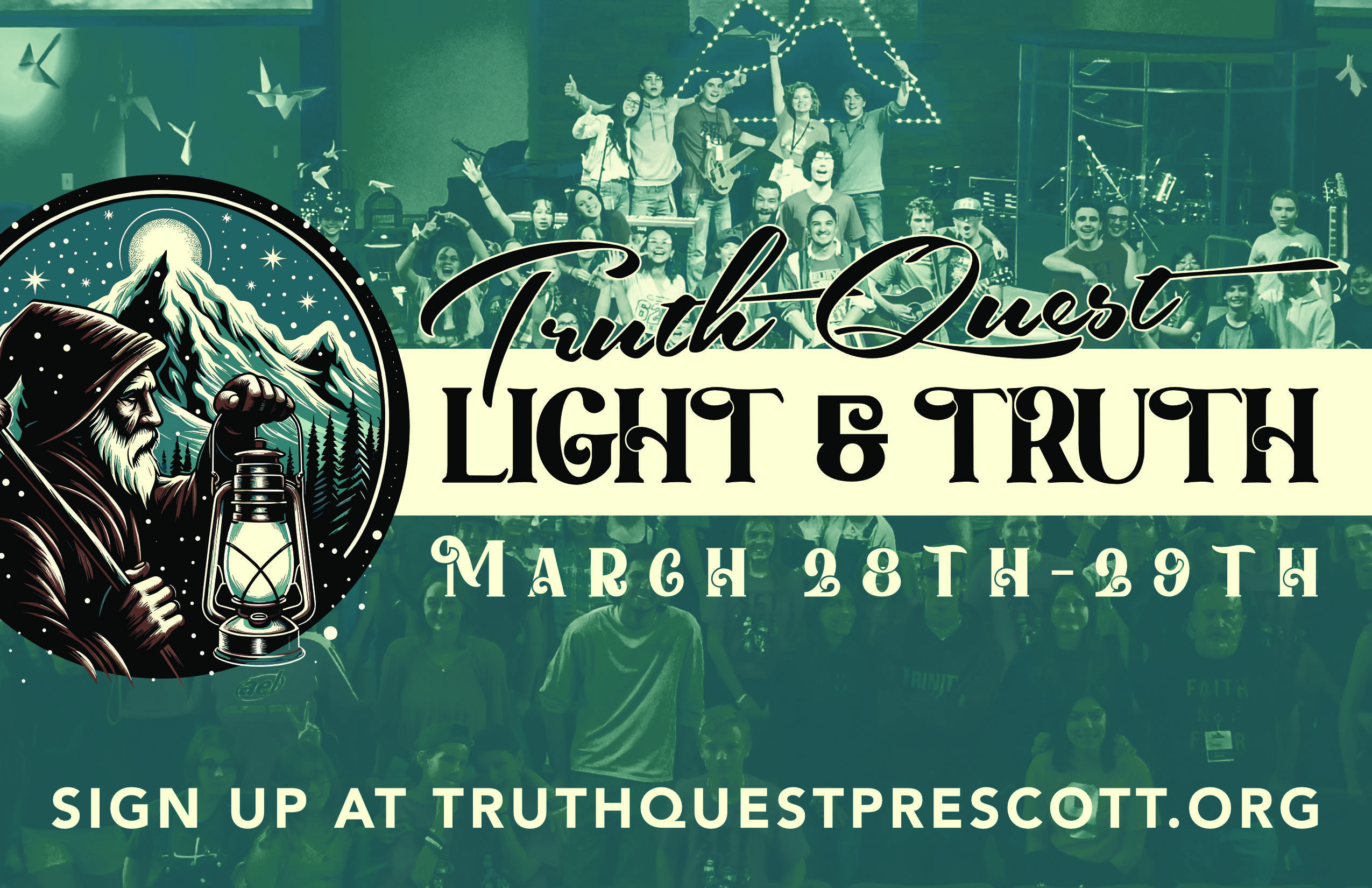
Truth Quest 2025: Doubt & Deconstruction: How Do I Keep My Faith?

The annual Truth Quest Youth Apologetics Conference in Prescott, AZ, happened again! The theme this year was “Light & Truth”. It was Friday and Saturday, March 28-29, 2025, and I was blessed and able to change it up this year and give a presentation on Doubt & Deconstruction.

The extra blessing this time was my helpful panel for QnA discussion. Abi Marshall from Cornerstone Church and both Noah Ulrich and Freddy Garcia from Quad City Church filled out the panel.

Below are the video, my presentation, and the notes. (As usual, I mostly stuck to notes, but not completely.)

(Oh, and my hat states, “Be Nicene. It’s that simple.” with the chi rho symbol making the “p” in simple. It can be found at the More Than Cake store.)

TQ25 – Workshop: Doubt & Deconstruction: How can I keep my faith?

(Recording from the event by the host: https://youtu.be/BnuptZ6b-IQ?si=wOammWbBKAZG4CED)

My presentation (slides): https://prezi.com/view/QVKTOsS1vJ48wTehlPbg/

Doubt can be scary.

  • Doubt is called the enemy of faith.
    • Jesus said that if we have faith and DO NOT DOUBT, we could command a mountain to be thrown into the sea (Matthew 21:21; Mark 11:23).
    • James said to ask for wisdom without doubting or be like one tossed on the sea, unstable in our thinking (1:5-8).
  • Many preachers and teachers have said to never ask questions, just have faith.
    • Doubt is often associated with fear, and John says there is no fear in love (1 John 4:18).

Yet,

  • Jude said to have mercy on those who doubt (1:22), and even some who followed Jesus after the resurrection had doubts (Matthew 28:17).
  • King David asked where God was (Psalm 22), or the other psalmists who wondered if God was truly helping (ex: Psalms 74, 77, 79, 88), yet they still reached out for God.

What about people who doubted in the Bible?

  • Abraham – Was not sure he could have children in his old age (even trying to make it happen.)
  • Moses – Doubted he could be used by God.
  • Elijah – Doubted he could be kept safe, even after defeating 450 priests of Baal miraculously.
  • Mary?
    • Was not sure how she could have a child without a husband. (Luke 1:34)
    • May have doubted Jesus’ sanity (Mark 3:21)
    • Mary Magdalene – Doubted Jesus’ resurrection
  • John the Baptist – Was imprisoned and had doubts that Jesus was the coming Promised One.
  • Thomas – Doubted Jesus was really resurrected.
  • John Mark – Doubted he could be useful or safe when sharing the gospel (and then wrote the Gospel of Mark).

What is “deconstruction”?

Many if not most who deconstruct their faith begin with doubts.

• Doubts that the Bible is reliable.
• Doubts that Jesus said/did the things in the Bible.
• Doubts about how Christians treat others.

Most of the prominent people who deconstructed said it was usually one of four things:

  • Christians avoiding talking about difficult things, including Bible passages and Christian history;
  • Christians being unscientific or anti-scientific;
  • Christians not loving neighbors through accepting LGBT, other faiths, or immigrants;
  • and pastors, teachers, and others abusing power, making “it all about them,” or spiritually abusing others.

When it comes to defining deconstruction, Alisa Childers and Tim Barnett, in chapter 1 of their book The Deconstruction of Christianity, argue that there is not a clear definition, finding as many as eleven definitions in their research.

Deconstruction broadly can be understood as moving away from historical Christian teachings and often to de-converting, or it can be understood as the process of re-examining the beliefs you grew up with (p. 10).

We should be careful, though, as most who proclaim their deconstruction publicly have fallen away from the faith, but even Alisa Childers explained in her first two books (Another Gospel and Live Your Truth & Other Lies) that she went through a deconstruction due to her pastor (at the time) but came out stronger.

It helps to know that deconstruction has its roots in the teachings of French philosopher Jacques Derrida. He argued that words do not have inherent meanings, so everything should be questioned, especially in literature, philosophy, and political institutions. The only context of words is what we make of them.

This gets applied to religion when we begin to question the meanings of biblical texts and role of the Church. Most people have never heard of Derrida, but they apply his methods when they begin to have doubts about what is true (usually based on how they feel.)

Let’s start with a simple syllogism:

Premise 1: Words do not have inherent meaning.
Premise 2: If no one agrees on the meaning, then I can decide what everything means.
Conclusion: I decide what is right and wrong based on my own definitions.

What is wrong with this argument?

[Why argue there is no meaning to then apply some meaning?]
[If there is no inherent meaning, then nothing is true. Yet people get upset when we define things the way they don’t like.]

The biggest issue is that this thinking uses Christian definitions of right and wrong while claiming there is no absolute right and wrong. Then, it is argued that Christians are those who are wrong based on derived definitions (that may change at any moment), and the Christians should accept the changing definitions as true.

“Let everyone decide what is right for them, and if you don’t then you’re wrong!”

[Judges 21:25b]

If these are all true, then it can be argued that, if God exists, He also changes with society. Or God can be whatever we want Him to be.

This is already seen in our culture.

If there is no absolute truth (a statement that refutes itself by having an absolute), then everyone can do what they want. But if there is absolute truth, then it must be discovered and applied.
If there is no absolute truth, how can anyone apply their truths to others? But if there is absolute truth, then it must be true for everyone.

Therefore, deconstruction is dangerous, because it removes meaning to be filled with whatever makes us feel better. We might use the ideas of some other people, but we don’t have to use the ideas of the original writers, including of the Bible.

“Who cares what the original intent was, this is how I see it.”

What keeps this logic from being turned around on the person deconstructing or transitioning or having some epiphany?
Deconstruction is dangerous because it makes personal circumstances and feelings general reality, feeding personal bias rather than seeking actual truth.

This then leads to falling into several logical fallacies:

  • Hasty generalization: applying to the whole from a small sample.
  • Strawman: claiming Christians believe certain things based on new definitions than the actual definitions historically used.
  • Ad hominem: attacking Christians for being horrible because of how others have acted.
  • Appeal to Authority: claiming authority that is not necessarily recognized, in this case personal experience as a greater authority than thousands of years of teachings and understandings.
  • And many more.
  • And to be fair, it is easy to fall into many fallacies when refuting those who fall away from Christianity.
    • For example, when it is claimed that all who deconstruct fall away (hasty generalization), that those who deconstruct just want to enjoy their sin and cause harm to others (potentially strawman and/or ad hominem), or that we have to believe because the Church has taught this for 2000 years (potentially appeal to authority.)
  • Because of these issues and problems, Childers and Barnett argue for saving deconstruction for those who fall away from the Christian faith.
  • What should I do?
    • Their suggestion is to say Christians go through “Reformation” rather than deconstruction.
    • Doubt is like pain. It is a warning of danger: Watch out for lies!
    • Don’t Lie or Avoid!
      • There is value in Derrida’s and the deconstructed people’s view of examining beliefs and definitions. Words do have meaning, but meanings can and do change. (Consider the word “gay” changing.)
    • Church hurt is real. It should be dealt with.
    • Abuses are real. People in power should be disciplined or removed for abusing power. Those who spiritually, emotionally, or physically abuse others should be removed from power, possibly even sent to prison.
    • Doubts are real. Sometimes from ignorance and sometimes from zeal for God, people avoid discussing certain topics.
  • We must be willing to tackle the hard problems with charity, love, and compassion in a reasonable manner.
  • There are passages that seem problematic, possibly contradicting or inconsistent.
    • To claim they have never been talked about or addressed is either a lie or a sign of laziness in research. The Bible has been attacked for 2000 years, yet it continually withstands the attacks, either because they were weak attacks or refuted.
    • No, the Bible does not support polygamy when it discusses all the men who married multiple women. It does not support chattel slavery (like seen in the colonies and nation of America in the 1600-1800s), as stealing people and treating them like animals or worse is specifically condemned.
  • There are words that change meanings, but intent in meaning matters.
    • It’s true that the word “homosexuality” was invented in Germany in the 1860s and not put into an English translation of the Bible until the Revised Standard Version of 1946 used it in 1 Corinthians 6:9. Yet, the original meaning of both “homosexual” and “arsenokoitai” (the Greek term Paul wrote) is the same.
    • It’s true that the King James Bible and others mention unicorns and dragons, words that mean “animals with one horn” and “scaly lizards” in a general sense. (The original 1828 Webster’s Dictionary even saying “unicorn” often refers to a rhinoceros, and consider the Komodo dragon also known as the monitor lizard.)
  • The Bible was not compiled at Nicaea and then translated and retranslated over and over throughout the centuries.
    • The Council of Nicaea primarily was to resolve the Arianism debate and set a standard date for Easter (not a pagan holiday) amongst some other items. We have manuscripts going back to the 2nd Century for the New Testament (possibly the 1st Century, but either way within 100 years of the writers) and before the time of Christ for the Old Testament (showing they were written before His life on Earth) that show the same texts as manuscript copies from the past 1000 years. Nearly all the changes are minor spelling differences or word order, nothing affecting doctrine. Modern translations look at all available manuscripts (families) to be as close to the original as possible. Translations also deal with language drift and changes. (“Nice” originally meant something quite opposite to today.)
  • People have done horrible things in the name of God and the Church.
    • This can be a reason for doubts, but if it is the only reason that is foolish. People have done horrible things for all sorts of reasons. We don’t avoid all restaurants for some bad service at one restaurant. We don’t avoid YouTube or TikTok because of some bad videos people made. Remember, atheists have done horrible things, people in other religions have done horrible things. We should focus on what the founder of Christianity called for (no, it was not Paul). If we can love the teachings but not the followers, then actually look at the teachings.

Our response should always be the same:
No one can have 100% assurance of anything in this life (at least from a scientific point of view.)
It’s okay to say, “I don’t know” or “Let me look into that.”
Have mercy on those who doubt (Jude 1:22). Love others and listen to them (Lev. 19:18; Matt. 22:39; Mark 12:31; Luke 10:27; Romans 13:9; Galatians 5:14; James 1:19-20 & 2:8). Be honest (Luke 8:15). Seek truth (John 4:23) not “my truth” (Romans 2:8).

Bibliography:

  • Childers, Alisa and Tim Barnett. The Deconstruction of Christianity: What it is, why it’s destructive, and how to respond. Carol Stream: Tyndale House, 2023.
  • Lawlor, Leonard, “Jacques Derrida”, The Stanford Encyclopedia of Philosophy (Summer 2023 Edition), Edward N. Zalta & Uri Nodelman (eds.), accessed March 7, 2025, https://plato.stanford.edu/entries/derrida/
  • WebstersDictionary1828.com, s.v. “unicorn,” accessed March 7, 2025, https://webstersdictionary1828.com/Dictionary/unicorn.

Video Lesson: Plagues & False Hopes

We are getting close to the Passover time of year! How fitting that we are currently in the middle of the coronavirus pandemic at the time of posting this!

Why? Because the Passover started during … THE 10 PLAGUES ON EGYPT!

You should read Exodus chapters 7-12 before reading/listening to this lesson.

Here are some questions to ask ourselves:

Does God allow or even send things like pandemics and plagues?

Is there a purpose to suffering?

Can God use evil for good? How do we define good and evil?

Now, to the big question of the day:

Can we learn from the 10 Plagues today?

Plagues and False Hopes
Exodus 7-12

Ten/10 is the number of completion, so God’s judgment is thorough and complete.

God gave Egypt plagues for each of their most powerful gods and goddesses.

  • #1 – Plague of the Nile into Blood
    • Hapi – god of the Nile
      This lasted 7 days, the number of perfection.
  • #2 – Plague of Frogs
    • Heket – goddess of Fertility and Water
      She had the head of a frog. Magicians made more frogs appear, but only Moses and Aaron could get rid of them.
  • #3 – Plague of Gnats/Lice/Mosquitos
    • Geb – god of the Earth
      1st plague the magicians couldn’t copy
      (8:18-19)
      Remember that we are made from the dust of the earth (Genesis 2:7)
  • #4 – Plague of Flies
    • Khepri – god of creation, movement of the Sun, and rebirth
      He had the head of a fly.
  • #5 – Plague of the Death of Livestock
    • Hathor – goddess of Love and Protection
      She had the head of a cow
      Economic disaster: food, transportation, and farming is affected.
  • Plagues 1-5 remove sources of sustenance and income.
  • #6 – Plague of Boils
    • Isis – goddess of Medicine and Peace
      Egyptians were neat-freaks and germophobes.
      This plague announced their uncleanness.
  • #7 – Plague of Hail and Fire & Brimstone
    • Nut – goddess of the Sky
      First plague to affect the household of Pharaoh himself.
      Affected the crops of flax and barley: used for making clothing and beer. The Egyptians would not be able to cover their nakedness nor “forget their woes” with alcohol.
      Wheat was not affected, showing God provides bread …
  • #8 – Plague of Locusts
    • Set – god of Storms and Disorder
      Locusts eat everything. This devastates even the food supply.
  • #9 – Plague of Darkness for Three Days
    • Ra – The Sun god, the highest god
      Their god of light was controlled by God.
      Darkness symbolizes spiritual blindness and death, judgment and hopelessness.
  • Plagues 6-9 remove sources of health and peace.
  • #10 – Plague of the Death of the Firstborn
    • Pharaoh – the living god
      If their worshiped king cannot stop a foreign deity from killing his son, is he really worthy of their worship? (No.)
      Most obviously, this points to Christ, the only Son of God and firstborn of the Resurrection, all others finding salvation from death through His shed blood.
  • Plague 10 removes our self-reliance.

God will allow and even send calamities, pestilences, and pandemics to show His power and sovereignty, and He might also do it to bring judgment on nations.

Think of the coronavirus pandemic sweeping the world, or the locust swarms in Africa at this time. Or think of all of the wildfires in 2019.

Is this a buildup to Christ’s return? Maybe. Maybe not.

At the very least, God is in control, and our world has been pushing Him away like crazy. Just as the Egyptians claimed differing gods and had prophets declaring false things, we see this all over the world today, even within Christianity.

Just as the only salvation from death in the 10th plague was blood, the only way we know we are saved from eternal death is through the blood of God’s firstborn, Jesus Christ. We may not escape earthly suffering, but we are saved from eternal judgment. (And see the last lesson about those who have not heard the Gospel!)

Complete Forgiveness

Forgiveness is such an important topic and yet it is perhaps one of the hardest to not only grasp, but articulate. However, nearly two decades ago I heard a pastor being interviewed about a book he had written on forgiveness, and the interviewer asked “What is the primary way you know that you have totally forgiven someone?” The pastor replied simply “When you can sincerely wish them well and ask God to bless them.”

The moment I heard this, it’s as if I had just received a little treasure, for all of us have people who have hurt us, some very deeply, and it’s even more important for us to forgive, than it is for them to receive it. At that moment, I integrated that nugget of wisdom into my life and it has helped me on the path of forgiveness throughout the years. The Pastors’ name is R.T. Kendall and his book is called “Total Forgiveness.” It should be, in my opinion, required reading for every Christian.

Something I have encountered in life is that forgiving is particularly difficult when the hurt is perpetrated by someone who should know better, such as a pastor. They should know better, but clearly they do not, which is why Jesus said regarding the Jewish leaders who sneered at him upon the cross, “Father, forgive them, for they know not what they do.” Even though they should have known better, they did not, and regardless of the fact that they should have known better, Jesus still asked the Father to forgive them.

Some hurts are so painful that we have buried them deep down in our hearts so that we don’t feel the pain, but that doesn’t fix it. When you bury things in your heart, whether it’s unforgiveness, sin, emotions, etc., there is less and less room for Jesus. What have you buried in your heart? Who do you need to forgive?

About Jesse Walker